
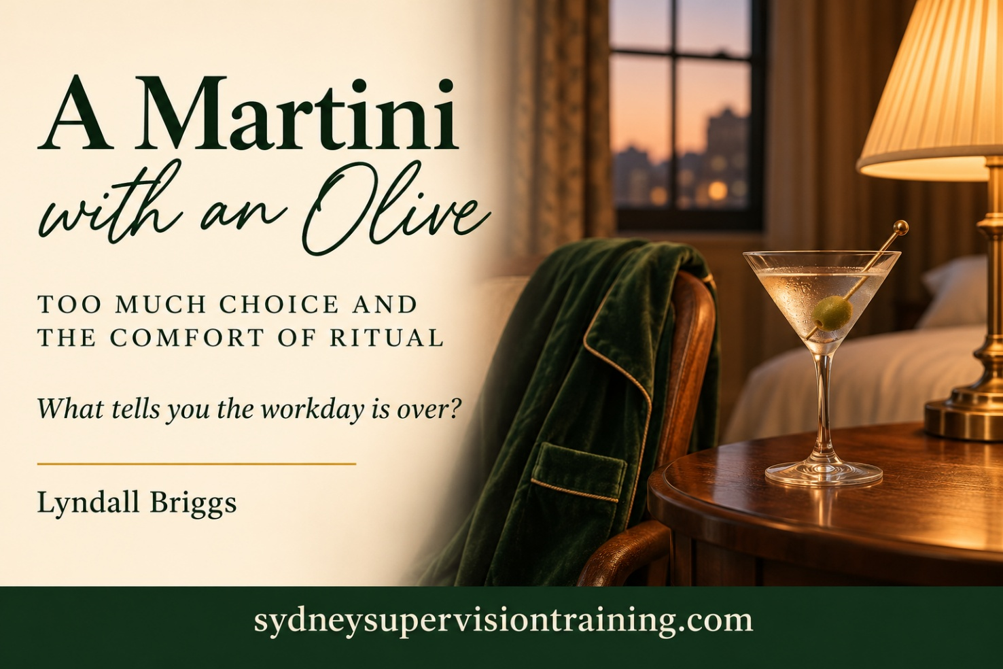
What Future Shock can teach us about too much choice and the comfort of a familiar ritual
By Lyndall Briggs
I read Alvin Toffler’s Future Shock when I was young. It influenced the way I saw things, although if you’d asked me years later what I remembered most clearly, I’d probably have said the olive.
As I remember the story, Toffler described a troubleshooter for an international company. Wherever there was a problem, off he went. This was before Zoom or the internet, so being needed somewhere meant actually going there. Someone asked him how he managed without a settled home. His wife travelled with him, he explained, and at the end of the day he would come back to the hotel to find her there, along with his smoking jacket and a martini with an olive.
I’ve never forgotten that. The hotel could be anywhere. The end of the day had a shape he recognised. There was someone familiar there, and a little ceremony that told him the workday was over. I think it was the olive that made it real for me. A martini was apparently insufficiently specific.
How much choice do we want on a Tuesday?
Future Shock was published in 1970. Toffler’s idea was that the speed of change can affect us as deeply as the change itself. He saw three things happening together. More of life was becoming temporary. More of it was unfamiliar. And more of it required us to choose. He called that last problem overchoice. Future Shock chapter listing
I like having choices. But it’s possible to spend twenty minutes comparing appointment times and still come away without an appointment. And there’s a particular sort of weariness that comes from sitting down to do something ordinary, like pay a bill, and discovering that first you have to learn how to pay a bill again.
Any one of these changes might be welcome. The new booking system might be easier. The new way of doing your notes might save time once you’ve learnt it. But you’re learning both while deciding which messages need an answer, which training is worth doing and whether you need to know more about AI by Friday. I wonder how often we judge a change on its own merits and forget that the person dealing with it has had several others land that week.
What tells you the workday is over?
This is where I think about supervision. Imagine a counsellor saying, “I used to enjoy this work. Now I’m watching the clock.” I’d be curious about what her day used to look like. Perhaps she once had ten minutes between clients and a colleague she could have a cup of tea with. Now she writes her notes after dinner. When, exactly, does she get to feel finished?
I can also imagine myself hearing all this and reaching for a good reflective exercise. It’s tempting. We supervisors do like a useful question, and some of us are quite attached to our handouts. But there are days when a person has already made enough decisions. A familiar opening to supervision can be a relief. “What’s stayed with you since we last spoke?” gives them somewhere to begin, even if what comes next surprises both of us.
That’s the bit of the martini story I keep coming back to. A ritual can take one small decision out of the day. It can also mark a transition we might otherwise miss. A walk after the last client, a few minutes with a colleague, even shutting the office door and hearing it click. And if there’s scarcely time to get to the bathroom between appointments, I’d want us to talk about the diary and who gets to set it. The cup of tea needs somewhere to go. I wonder what your version of the olive is. What small, familiar thing tells you that, for today at least, you can stop deciding what comes next?