
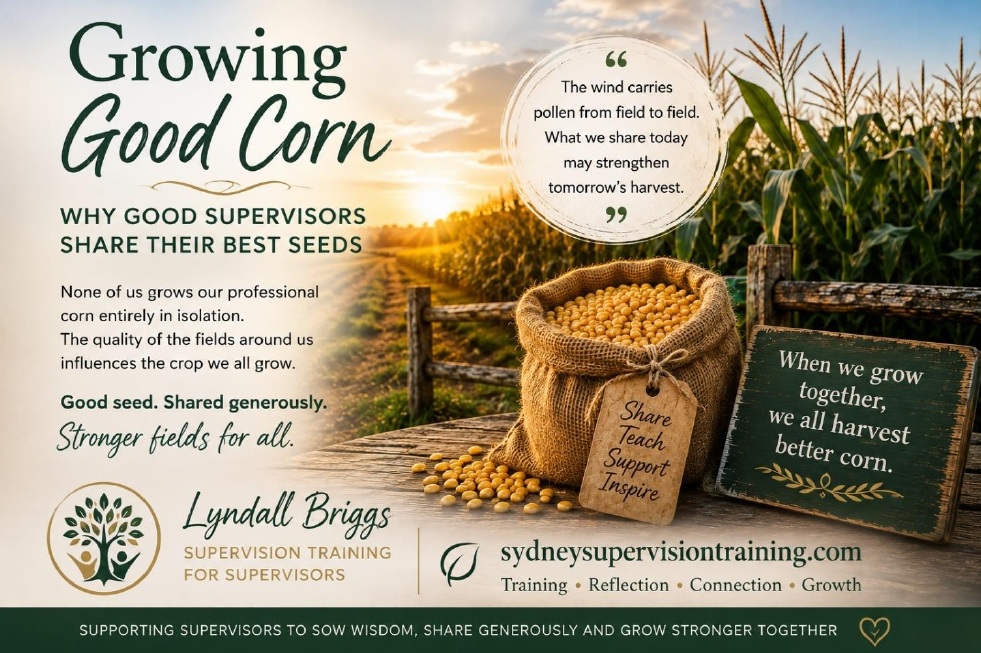
Growing Good Corn – Why good supervisors share their best seeds
There is an old story, retold in various forms over many years, about a farmer who
became known for growing exceptionally good corn. Year after year his crop won
prizes, and eventually someone interviewing him discovered something rather
surprising. The farmer willingly shared his best seed corn with the farmers whose
fields surrounded his own.
At first this seemed an odd thing to do. These were, after all, other farmers growing
the same crop. Why would someone who had worked hard to produce exceptional
corn give away the very seed that contributed to his success?
The farmer understood something about corn.
As the wind moves across neighbouring fields, it carries pollen with it. Corn does not
grow entirely in isolation from the crops around it, and the farmer knew that if inferior
corn was growing nearby, cross-pollination could eventually affect the quality of his
own crop. If he wanted to continue growing good corn, it was in his interests for his
neighbours to grow good corn too.
I have always liked that story, perhaps because it reaches well beyond farming.
Over many years of practice, supervisors accumulate an extraordinary collection of
seeds. Some come from formal training and professional development, while others
are gathered much more slowly through experience. We discover questions that
open conversations, ways of offering difficult feedback, models that help us think,
approaches that did not work as well as we hoped, and small pieces of wisdom that
are difficult to find in any textbook because they have been learned through sitting
with people.
Eventually we have a choice about what we do with all of that.
Professional knowledge can sometimes be treated as something to protect. We
worked hard for it, paid for the training, spent years developing our skills and
perhaps learned some lessons rather painfully. It can therefore seem reasonable to
hold our best seed rather closely.
Yet supervision does not take place in an isolated field.
The practitioners we supervise work alongside other practitioners. Their clients may
have previously worked with someone else and may work with someone else again.
Supervisors influence supervisees who eventually become supervisors themselves.
Ideas travel through professional conversations, training rooms, peer groups and
organisations, often moving much further than the person who first shared them will
ever know.
One thoughtful question offered to another supervisor may eventually find its way
into dozens of supervision conversations. A useful way of understanding an ethical
dilemma may influence practitioners we will never meet. Even the willingness to
speak openly about something we got wrong can give another supervisor permission
to examine their own practice more carefully.
In that sense, the pollen is always moving between our fields. Of course, generosity
does not guarantee that everybody will plant good seed.
This may be the less comfortable part of the metaphor. We can share knowledge
freely and discover that someone has little interest in it. We can offer thoughtful
professional development and watch people choose something easier. We can
encourage reflective practice while others seem quite content to keep doing what
they have always done. Sometimes it can leave us wondering why we bother
continuing to share our best seed when someone in the next field appears
determined to plant the cheapest seed they can find.
Perhaps the farmer has something to teach us here as well.
He could not control what his neighbours planted. Sharing his best seed did not give
him ownership of their fields, nor did it make him responsible for how carefully they
tended them. His responsibility was to cultivate his own crop as well as he could and
to recognise that contributing to the quality of the fields around him was ultimately
better than pretending those fields had nothing to do with his own.
There is an important distinction here for supervisors. Sharing generously does not
mean insisting that others think as we think, supervise as we supervise or value
every idea we offer. Good seed is an offering, not an instruction. Once shared, it
belongs in someone else’s field, where it may be used, adapted, combined with
something different or occasionally left unplanted.
Perhaps what matters is the professional environment we help create around us. A
culture in which supervisors exchange ideas, acknowledge uncertainty, discuss
mistakes, share resources and remain curious about one another’s work is likely to
produce something quite different from a culture in which expertise is guarded and
everyone tends their own small patch.
None of us grows our professional corn entirely in isolation. The standards,
knowledge, generosity and curiosity of the people practising around us eventually
influence the profession we all share. We cannot decide what everyone else will
plant.
We can only continue tending our own field, growing the best corn we know how to
grow and, when we have good seed to spare, being willing to pass some across the
fence.
Because sometimes the best way to protect the quality of your own field is to care
about what is growing in the fields around you.