
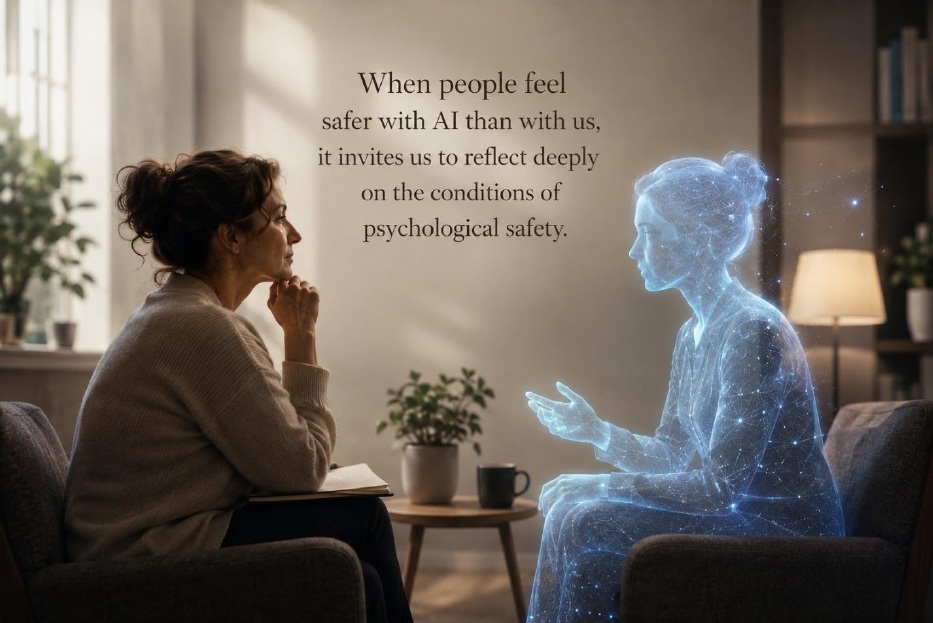
If Clients Feel Safer with AI Than With Us… What Does That Teach Us?
By Lyndall Briggs
Over recent months I have found myself engaged in an increasing number of
conversations about artificial intelligence. Like many clinicians, I have been curious
about its capabilities, cautious about its limitations and intrigued by the many
predictions about the impact it may have upon psychotherapy, supervision and
clinical hypnosis. Some believe it represents the beginning of a profound shift within
the helping professions, while others regard it as simply another technological
development that will eventually find its place alongside the many innovations our
profession has witnessed over the years.
Yet the more time I have spent reflecting upon these conversations, the more I have
realised that my interest lies elsewhere. It is not AI itself that has captured my
attention. Rather, it is what people’s responses to it may be teaching us about
ourselves and, perhaps more importantly, about the conditions under which people
become willing to think, to reflect and ultimately to change.
Over the past year I have heard one comment repeated often enough that I no
longer regard it as unusual.
“I’ve told ChatGPT things I’ve never told another person.”
The first time I heard those words my instinct was to think about technology. How
had a machine become sufficiently sophisticated that people were willing to disclose
deeply personal thoughts? Yet the longer I sat with the idea, the less convinced I
became that technology was the real story. Gradually my curiosity shifted away from
AI itself and towards a rather different question.
Why would someone feel safer speaking to an artificial intelligence than to a human
being?
It is, I think, an uncomfortable question for those of us who have devoted our
professional lives to developing therapeutic relationships. We naturally believe that
another human being offers something no machine could ever replace, and I
continue to hold that view. Therapy is infinitely richer than an exchange of
information. It is built upon presence, empathy, intuition, lived experience and the
countless subtle moments of human connection that emerge when people are fully
present with one another. I do not believe AI can reproduce those qualities, nor do I
believe that technology will replace the therapeutic relationship.
Nevertheless, the question remains. Why are some people willing to reveal thoughts
to an AI that they have never shared with a person?
The answer, I suspect, has rather less to do with AI than with safety.
As I reflected upon this, I found myself thinking less about AI and more about the
invisible calculations every client makes before they begin to speak to us. We often
imagine that disclosure begins with the first therapeutic question, yet I have come to
wonder whether another conversation has already taken place long before we ask it.
Can I trust this person?
Will they understand me?
If I reveal what I am really thinking, will they see me differently?
Will I be judged?
Can I admit uncertainty?
Can I say something that makes little sense while I am still trying to understand it
myself?
These questions are rarely spoken aloud, yet I suspect they quietly shape every
therapeutic encounter. They influence not only what clients choose to reveal but also
what they soften, edit or leave unsaid altogether. Long before therapy begins in any
formal sense, another part of the mind is already deciding whether this is a place in
which it is safe to think aloud.
I have often reassured anxious clients that there is no correct way to begin therapy,
no expectation that they should know exactly what to say and no pressure to present
themselves in a particular way. Such reassurance is important, yet I have
increasingly come to believe that psychological safety cannot simply be explained; it
has to be experienced. Clients do not decide that they are safe because we tell them
they are. They arrive at that conclusion through a series of experiences, many of
which occur before they are consciously aware that a decision has been made.
This has led me to wonder whether the opposite of psychological safety is not fear at
all. Perhaps it is something quieter and, for that reason, more difficult to recognise.
Perhaps it is self-censorship.
Many clients do not arrive frightened of their therapist. Rather, they arrive carefully
editing themselves. They disclose a little, observe our response and then decide
whether it is wise to continue. They notice our facial expressions, our tone of voice,
our capacity to tolerate silence and our willingness to remain with uncertainty. In
ways that are often outside conscious awareness they are asking a remarkably
simple question.
Is it safe to think out loud here?
Looking back during my years of practice, I find myself wondering whether that
question has been present in every first therapy session I have ever conducted. I
simply did not recognise it for what it was.
That question has remained with me because it seems to sit beneath so much of
what we do as therapists. We speak frequently about rapport, empathy and the
therapeutic alliance, all of which are supported by research and clinical experience,
yet I now find myself wondering whether these concepts describe the experience of
psychological safety rather than fully explaining how it develops.
Thinking about this also brought to mind Claude Steiner’s work on stroke theory
within Transactional Analysis. His observation that human beings are fundamentally
“stroke hungry” has always resonated with me because it captures something deeply
human. We all need recognition. We need to know that we have been seen, heard
and acknowledged by another person. Recognition affirms our existence within
relationshipsand reminds us that we matter. It is a beautiful idea and one that has
rightly remained influential for many decades.
Yet as I continued reflecting upon the conversations surrounding AI, I found myself
wondering whether psychological safety points towards something even more
fundamental. Recognition undoubtedly matters, but before recognition can become
therapeutic there must first be sufficient safety for another person to reveal the parts
of themselves that most need recognising.
A positive stroke offered too early may still be experienced as judgement. Advice,
however well intentioned, may unintentionally close down curiosity. Even empathy, if
offered before a client genuinely feels understood, can sometimes miss the mark. I
wonder whether the first task of the therapist is not to respond but to create the
conditions in which another human being gradually discovers that they no longer
need to protect themselves quite so carefully.
In many respects I think this has always been understood by some of the great
contributors to our profession. Although Milton Erickson and Carl Rogers
approached therapy from very different traditions, both demonstrated a profound
respect for the client’s own capacity to discover meaning when provided with the
right relationship. Neither appeared to be in a hurry to reach insight before the client
was ready. Both seemed willing to trust that, given sufficient acceptance, curiosity
and time, people often discover far more for themselves than another person could
ever tell them.
As I have continued to reflect upon this, I wonder whether what we have always
been trying to create is something rather more subtle than I had previously
appreciated. We often speak about the importance of the concepts that shift the
focus from emotional resonance and interpersonal bonding to cognitive
collaboration, practical skill-building, or clinical technique. These frameworks
prioritize actionable progress over the therapist’s ability to “feel” what the client is
experiencing, and rightly so, but perhaps these are not the destination so much as
the pathway. Perhaps what they ultimately offer another human being is permission –
permission to wonder without embarrassment, to hesitate without feeling inadequate,
to acknowledge that they do not yet know, and to remain with an emerging thought
long enough for it to reveal something of itself before it is judged, explained or
dismissed. If that is so, then perhaps it is within this quiet experience of permission
that psychological safety begins to replace self-protection, and genuine reflection
becomes possible.
When I think about the moments that have remained with me throughout my career,
they have rarely been those in which I felt particularly clever or insightful. More often
they have been the quiet moments when a client has looked up, almost with
surprise, and said,
“I’ve never said that out loud before.”
For many years I regarded those words simply as an indication that therapy was
progressing. Looking back now, I wonder whether they signified something far more
important. Perhaps they marked the quiet moment at which psychological safety
became stronger than self-protection.
Perhaps that is where therapy truly begins.
If that is indeed where therapy begins, then it also raises another question that I
suspect many of us have rarely considered consciously. How do clients decide that
another human being is psychologically safe? What is it that allows one relationship
to invite openness while another, often despite the best of intentions, leaves a
person feeling that some part of themselves is still better left unspoken?
For much of my professional life I would have answered that question by speaking
about rapport, empathy, unconditional positive regard or the therapeutic alliance. All
remain central to our work and are supported by decades of research and clinical
experience. Increasingly, however, I have come to wonder whether these concepts
describe the experience of psychological safety rather than fully explaining how it
develops. Psychological safety is not created through a particular intervention or
technique. Rather, it emerges gradually through many small experiences that
communicate a person does not need to perform, defend or justify themselves in
order to be accepted. It is experienced rather than announced and, for that reason,
often develops so quietly that neither therapist nor client can identify the precise
moment it has emerged.
Looking back, I have become increasingly aware that this understanding has quietly
influenced decisions I made before I had language for it. Therapy begins long before
the first therapeutic question is ever asked. It begins with the first telephone
conversation, the wording of an email, the atmosphere of the waiting room, the pace
at which we greet someone, and whether we seem hurried or genuinely available.
Before any formal intervention takes place, people are already beginning to decide
whether they feel safe enough to trust us. Every aspect of that first encounter
communicates something about the relationship that is about to unfold and, although
none of these moments appears particularly significant in isolation, together they
begin to answer the question every new client carries with them.
“What sort of place is this?”
Previously I found myself reflecting upon this while deciding where to display the
information required by the Health Care Complaints Commission. Like every
practitioner, I fully support the requirement. Clients should know their rights,
understand the standards to which we are accountable and have clear avenues
available should something go wrong. These protections are essential and
strengthen public confidence in our profession.
Yet I also found myself thinking about the emotional experience of the person sitting
quietly in the waiting room before their first appointment.
Many clients arrive carrying far more than the presenting problem that eventually
brings them to therapy. They bring uncertainty, apprehension and, not infrequently,
the quiet hope that this might finally become a place where they can speak without
needing to protect themselves quite so carefully. Sitting alone, waiting to meet a
stranger, they notice everything around them. They read what is placed before them.
They search, often unconsciously, for clues about the relationship they are about to
enter.
For that reason, I chose not to place the HCCC notice where it would become the
very first thing a new client encountered. The information remained available exactly
as required, but it appeared a little later rather than greeting them before we had
even met.
At the time I doubt that I could have explained why that decision felt important.
Looking back now, however, I wonder whether I was responding intuitively to
something that I have only recently found words to describe.
There is, I think, a difference between regulatory safety and psychological safety.
The first protects people if something goes wrong. The second creates the
conditions in which trust has the opportunity to develop. One reflects our ethical
responsibilities as practitioners. The other reflects the emotional experience of the
person seeking our help. Both matter deeply. Neither replaces the other.
Yet they serve different purposes, and perhaps our task is to ensure that while clients
understand their rights, they also encounter an environment that quietly
communicates another equally important message: you are welcome here; you do
not need to have everything worked out before we begin; together we can simply
become curious.
As I reflected upon this distinction, I realised that my curiosity about AI had gradually
shifted. I found myself becoming less interested in what AI could do and more
interested in what people’s responses to it might reveal. Technology had not
suddenly created the human need for psychological safety. That need has always
existed. What AI seems to have done is make it more visible.
When people describe feeling safe enough to disclose personal thoughts to an AI
entity, I do not believe they are suggesting that technology offers a richer therapeutic
relationship than with a human being. Rather, I suspect they are describing
something much simpler. They are describing an experience in which they feel able
to explore an idea without immediately anticipating judgement, disappointment or
misunderstanding. Whether that perception is entirely accurate is almost beside the
point. It reminds us that before people can benefit from our knowledge, our skills or
our therapeutic interventions, they must first feel sufficiently safe to discover what it
is they truly wish to say.
I have gradually come to realise that this simple observation sits at the heart of my
reflection. Before people can benefit from our knowledge, our skills or our
therapeutic interventions, they must first feel sufficiently safe to discover what it is
they truly wish to say.
Perhaps that has always been one of the quiet strengths of our work. Long before
we introduce technique, interpretation or intervention, we offer another human being
something that has become increasingly rare within contemporary life. We offer them
time. Time to think. Time to hesitate. Time to remain uncertain without feeling
inadequate. Time to discover that uncertainty need not be feared but can instead
become the beginning of understanding.
I believe this is also one of the great gifts of supervision. Good supervision does far
more than improve clinical skills or assist with complex cases. At its best, it offers
therapists the very experience we hope to create for our own clients. It becomes a
place where uncertainty can be spoken without embarrassment, mistakes can be
acknowledged without humiliation and curiosity is valued more highly than certainty.
Perhaps supervision, at its heart, is the practice of extending psychological safety to
those whose work is to create it for others.
As I look back over this reflection, I find it interesting that I began by thinking about
AI and have ended by thinking about the therapeutic relationship. Perhaps that is
because AI was never really the subject of my curiosity. It simply encouraged me to
look again at something that has always sat quietly at the heart of our profession.
Perhaps the greatest lesson AI offers is not technological at all. Perhaps it reminds
us that the deepest human need has never been simply to be heard.
It has been to feel safe enough to discover what we truly think.
When people experience psychological safety, curiosity naturally follows. Curiosity
creates space for reflection, and reflection allows new possibilities to emerge. Within
that process, change often develops quietly and almost unnoticed, not because
another person has persuaded us to become someone different, but because we
have finally felt sufficiently safe to become more fully ourselves.
Maybe that has always been the real work of therapy. The real work of supervision.
Indeed, the real work of every meaningful human relationship.
Not to tell people who they should become. But to create a space in which they feel
safe enough to discover it for themselves.
If AI reminds us to become even more intentional about creating relationships in
which people feel sufficiently safe to think aloud, to remain curious and to discover
what they truly believe, then perhaps its greatest contribution will not be
technological at all. Perhaps it will simply remind us of something that has always
been at the very heart of our work.
It may simply remind us of something we have known for a very long time, that
meaningful change begins not when people are given better answers, but when they
finally feel safe enough to discover their own.