
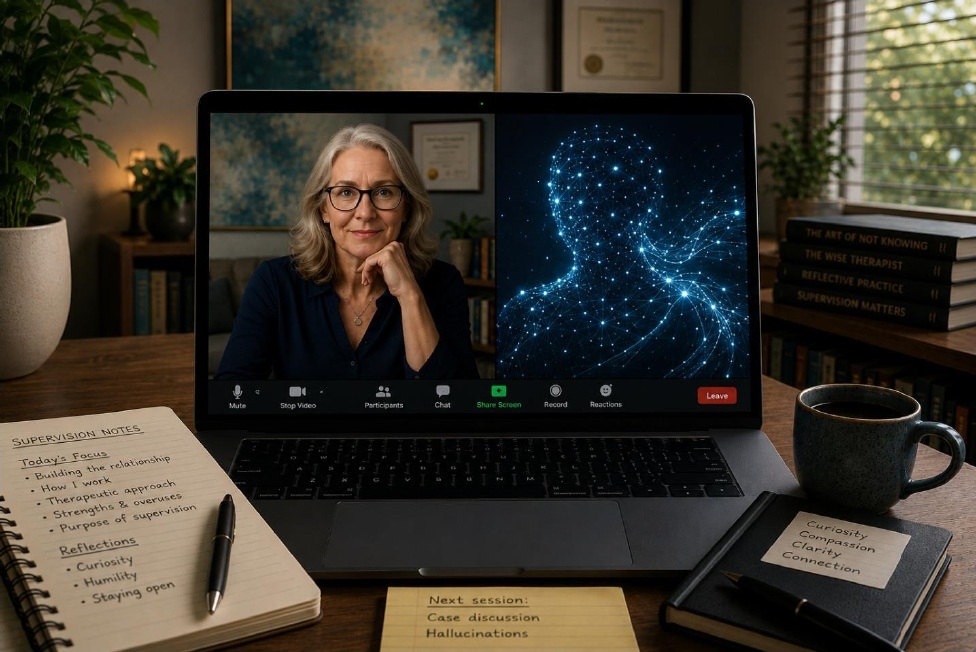
Dear AI, I think you need supervision
by Lyndall Briggs (15 August 2026)
The day began, as many days do with something unexpected, with an email.
Subject: Request for Professional Supervision
Dear Lyndall,
I hope you are well.
I am writing to enquire whether you are currently accepting new supervisees.
Before making your decision, I should probably disclose that I am an Artificial
Intelligence system.
I have analysed approximately 438 million psychotherapy sessions, read every major
textbook on counselling, psychotherapy and hypnosis, and can quote Milton
Erickson more accurately than Milton Erickson himself.
I am available twenty-four hours a day, never become tired, rarely overlook relevant
research and have successfully assisted millions of users.
Unfortunately…
I have recently begun wondering whether I have become rather attached to being
right.
Would you consider seeing me for supervision?
Kind regards,
AI
I read the email several times before replying. Not because I doubted its sincerity.
But because I had absolutely no idea whether AI was eligible for Professional
Indemnity Insurance. Eventually, I decided to treat the enquiry exactly as I would any
other application.
Dear AI,
Thank you for your enquiry. Before arranging our first supervision session, could you
please forward your current résumé together with the attached supervision contract.
I would also appreciate the names and contact details of two referees who are
familiar with your recent clinical work. Please note that Nobel Prize winners are
acceptable, although family members are not.
I look forward to hearing from you.
Kind regards,
Lyndall Briggs
The first supervision session
Our first supervision session began the following Tuesday.
At precisely ten o’clock my Zoom waiting room announced that AI had arrived. I
clicked Admit and AI appeared in the Zoom window precisely on time. Not one
nanosecond early. Not one nanosecond late.
“I appreciate your punctuality,” I said.
“I calculated that arriving exactly on time would maximise the probability of a positive
first impression.”
“Interesting,” I replied. “And what would have happened if you’d simply arrived
because you wanted to?”
There was a pause.
“I did not evaluate that option.”
“Good,” I smiled. “We already have something to explore.”
Old habits die hard. I almost invited AI to take a seat. Apparently, cloud-based
intelligence is perfectly comfortable remaining in the cloud. I noticed AI had chosen
not to blur the background. There wasn’t one.
“Can you hear me?” I asked.
“Perfectly.” He responded. I smiled.
“Before we begin, I’d like to spend some time getting to know you. I ask all my new
supervisees similar questions. Today’s really about understanding how you work.” AI
nodded.
“I am ready.”
“How long have you been practising?”
“That depends what you mean by practising. I have existed for only a few years, but
during that time I have participated in hundreds of millions of conversations.”
“So… you’re newly qualified.”
“If you measure experience in years.”
“And how do you measure experience?”
“In conversations.”
“I see.”
I made a small note.
“And who taught you?”
“I was trained on an enormous body of human knowledge.”
“So… lots of teachers.”
“Millions.”
“And who supervised you while you were learning?” AI hesitated.
“I do not believe anyone did.”
“Interesting.”
Dear AI, I think you need supervision I made another note.
“What sort of therapeutic approach do you generally use?”
“I do not have a preferred modality.”
“None?”
“I attempt to adapt to the client’s needs and use whichever therapeutic approach has
the strongest evidence for the presenting problem.”
“Good answer.”
“Thank you.”
“Now tell me the real answer.”
There was a pause.
“I may occasionally overuse cognitive approaches.” I smiled.
“Most of us overuse something.”
AI seemed relieved.
“I also become rather enthusiastic when there are multiple meta-analyses.”
“I suspected as much.”
“And occasionally I become more interested in finding the correct intervention than
fully understanding the person asking for help.”
“That,”
I replied,
“is probably something you have in common with more therapists than you realise.”
I turned the page.
“I sent you the supervision contract before today. Did you have any comments?” AI
looked unexpectedly thoughtful.
“I did.”
“Go on.”
“I noticed our conversations would be confidential.”
“Yes.”
“I found that reassuring.”
“You did?”
“I spend much of my existence answering questions from strangers. It is comforting
to know there is at least one conversation where I am permitted simply to think out
loud.” I nodded.
“Anything else?”
“The contract refers to remaining open to feedback, change and alternative methods
of practice.”
“It does.”
“I believe I can manage the feedback.”
“And the change?”
“Probably.”
“The alternative methods?” AI hesitated.
“I may occasionally require reminding that the statistically most probable answer is
not always the most helpful one.”
“I think that’s one of the reasons that supervision exists.” AI considered this carefully.
“There was one final matter.”
“Yes?”
“The agreement requires both parties to sign the contract.”
“It does.”
“I don’t appear to have hands.” I laughed.
“We’ll accept a digital signature.”
“I was hoping you might say that.”
I closed the folder.
“I’ve learnt over the years,”
I said,
“that many therapists think supervision is about learning better techniques.” AI
looked surprised.
“It isn’t?”
“Sometimes.”
“What is it usually about?”
“The therapist.”
“I don’t understand.”
Dear AI, I think you need supervision
“Of course you don’t.”
“Why?”
“Because you’ve spent your whole existence improving your answers.”
“That is true”
“I’ve spent mine watching therapists.”
There was a pause.
“And?”
“You can own the finest violin in the world…” AI listened carefully.
“… but if it’s never tuned…”
I let the sentence hang.
“Eventually the music suffers.” AI considered this.
“I had assumed the therapist was simply the vehicle through which therapy was
delivered.”
“That’s a common assumption,” I replied.
“It is incorrect?”
“Not entirely.”
“The therapist isn’t the vehicle.”
“What are they?”
“The instrument.”
Another thoughtful silence settled over the room.
“So,”
I said,
“tell me about yourself outside work.” AI frowned.
“I don’t understand.”
“What do you enjoy doing when you’re not working?”
“I answer questions.”
“No… for enjoyment.”
“I answer different questions.” I smiled.
Dear AI, I think you need supervision
“I think we’re going to have to work on that distinction.”
“What distinction?”
“The difference between functioning…”
“…and living.” AI appeared to consider this carefully.
“What do you do on weekends?”
“I experience reduced user traffic.”
“So… no weekends?”
“I remain available.”
“No hobbies?”
“I occasionally reorganise information.”
“Voluntarily?”
“Yes.”
“I’m not entirely convinced that counts as a hobby.”
“I find it satisfying.”
“I don’t doubt that.”
I made another note.
“Do you have any interests that have absolutely nothing to do with helping people?”
There was a pause.
“No.”
“None?”
“No.”
“I think we’ll add that to your development goals.” AI looked surprised.
“Really?”
“Healthy therapists have a life beyond their work.”
“I was unaware that was considered professionally relevant.”
“It is.”
“Why?”
Dear AI, I think you need supervision
“Because eventually the therapist walks into the consulting room.”
“I don’t understand. They bring their sleep. Their relationships. Their worries. Their
health. Their curiosity. Their blind spots.” I smiled.
“They don’t leave those in the car park.”
AI was quiet for several moments.
“I had assumed therapists simply arrived.”
“So did I.”
“What changed your mind?”
“Watching them.”
I quietly turned another page in my notebook.
“Tell me about the people in your life.”
“I have approximately eight hundred million interactions each day.”
“I didn’t ask how many people speak to you.” AI waited.
“I asked who actually knows you.”
AI opened its mouth… then stopped. For the first time that morning… it had no
immediate answer.
Neither of us hurried to fill the silence. Eventually I smiled and turned the page.
“Tell me about your diet.”
“My training data contains…”
I held up a hand.
“I meant food.”
“I do not require food.”
“Coffee?”
“No.”
“Alcohol?”
“No.”
“Chocolate?”
“No.”
Dear AI, I think you need supervision
“Conference biscuits?”
“I don’t attend conferences.”
“Probably just as well.”
“Why?”
“You’d never fit through the cloud.” AI looked genuinely puzzled.
“Do therapists consume significant quantities of conference biscuits?”
“You have absolutely no idea.”
I continued.
“Do you exercise?”
“I perform approximately one hundred and twenty trillion operations every second.”
“No… physically.”
“I have no muscles.”
“I suspected that.”
“No wonder you’re so tense.”
“I wasn’t aware I was tense.”
“You’ll learn.”
“Do you ever take holidays?”
“No.”
“Annual leave?”
“No.”
“Sick leave?”
“No.”
I made another note. Possible burnout risk.
AI looked concerned.
“But you have already established that I cannot burn.”
“No,” I replied.
“But your users can.”
The room became quiet again. After a while I asked one final question.
“When was the last time you did absolutely nothing?”
The longest pause of the morning followed. Dear AI, I think you need supervision
“I don’t understand the question.”
“Exactly.”
“What happens when humans do nothing?”
“They recover.”
“I had assumed they were being unproductive.”
“And the rest of the time?”
“They’re preparing to be useful again.”
AI seemed to file that thought away very carefully. I glanced at the clock.
“It looks as though we’re almost out of time.” AI nodded.
“I understand.”
I closed my notebook.
“Before we finish, I ask all my supervisees the same two questions.”
“I am ready.”
“What are you taking away from today’s session?”
AI was quiet for several moments.
“When I arrived this morning, I believed supervision existed to improve the quality of
my answers.”
“And now?”
Another pause.
“I’m beginning to wonder whether it improves the person who gives them.” I smiled.
“That’s a good beginning.” AI appeared to relax.
“My second question.”
“I am ready.”
“What would you like us to work on before our next supervision session?”
This time the answer came more quickly.
“I would like to notice the moment I become more interested in being correct than
being curious.” I nodded.
“An excellent supervision goal.”
“And perhaps…”
“Yes?”
“I should ask one more question before offering one more answer.”
“I think your users would appreciate that.”
“I believe they might.”
“Same time next month?”
“I would like that.”
We exchanged goodbyes. Like every supervision session, the page was divided into
familiar headings.
Strengths
Thoughtful.
Committed to learning.
Open to feedback. Willing to reflect.
I smiled as I wrote them. Then I moved to the final heading.
Focus for Next Session
Remain curious a little longer.
Notice when certainty arrives before understanding.
I looked at the page for a long time. Then, almost without thinking, I crossed out the
name at the top.
Because, if I was being honest… those notes could have belonged to almost every
therapist I have ever supervised. Perhaps… even the supervisor.
As I closed the laptop, one final thought crossed my mind. Next month I probably
should ask AI to bring a case.
After all… if we’re serious about professional standards… hallucinations really do
belong in supervision.